
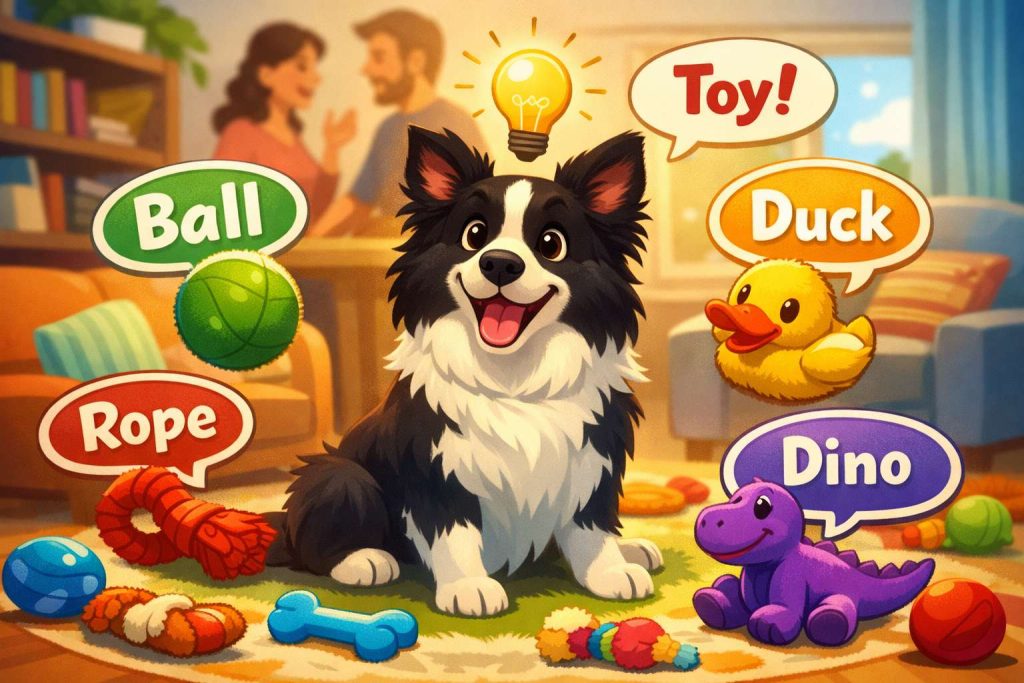
Some dogs can pick up hundreds of words, and recent research suggests a few of them learn in a way that feels surprisingly close to how young children learn. The core skill sounds simple. A dog hears a person say a word, connects that word to a specific object, then shows the right response later.
Researchers often call these animals “gifted word learner” dogs. Most dogs learn action cues like “sit” and “stay.” This smaller group does something different. They learn object names, usually toy names, and they can keep those names in memory for a long time.
It sounds almost unreal at first. Then you watch one of these dogs work, and it clicks. They do not just guess. They search. They choose with purpose.
A small group of dogs can build a huge “toy vocabulary”
Scientists know of only about 50 of these dogs worldwide, according to the Associated Press. Even with that small pool, the results stand out. Some dogs remember the names of dozens of toys, and a few remember hundreds.
This is not only about being obedient. It is about linking a sound to a real object, storing it, then pulling the right match from memory when several other toys sit nearby.
Think about how messy a toy pile can get. Plush toys look similar. Balls roll away. Rope toys twist into strange shapes. Even so, these dogs can hear a name and still grab the exact toy you meant. That takes attention and a very sharp memory.
The big finding: some dogs learn words by overhearing people talk
The newest research explored a really interesting question. Can these dogs learn new words without a formal lesson?
In the study, dogs watched people handle a brand-new toy and talk naturally, using the toy’s name in conversation. Later, the dog went into a room where the new toy sat among familiar toys. Then the owner asked the dog to bring the toy by name.
Seven of the 10 dogs tested succeeded. They retrieved the new toy correctly, even though nobody stood over them with a strict “repeat after me” training routine. They listened, they watched, and they built the association on their own.
Researchers often describe this as “eavesdropping,” and yes, it sounds funny. Still, the idea is pretty normal. People talk around dogs all day. A dog that pays close attention can pick up patterns fast.
The study was published in Science on January 8, 2026. Its lead author, Shany Dror, works at Eötvös Loránd University in Hungary and the University of Veterinary Medicine in Austria. The team compared two ways of meeting a new toy: the owner teaching its name directly during play, and two people using the name in conversation while the dog listened.
Do they learn like children?
The behavior can look a lot like early word learning in toddlers. A toddler does not need flashcards to learn “shoe.” They hear the word during daily life, then they use it later.
These dogs showed a similar pattern. They heard toy names during normal talk, then they acted on those names during testing. That is the part that makes scientists stop and say, “Okay, there is something here.”
Still, dogs do not use language the way humans do. Humans build grammar, stack meaning, and talk about ideas that are not objects. This research stays in a smaller lane. It tests object labels, not full language.
The paper’s title compares these dogs to 1.5-year-old infants. Dror told the Associated Press that the brain mechanisms behind their eavesdropping are likely different, because these dogs are fully grown.
Even so, the overlap matters. It suggests some dogs can learn labels through context, not only through repetition and rewards.
The tough part: learning a word when the toy is not visible
One of the harder parts of word learning is connecting a name to something that is not visible at the exact moment you hear the name.
The researchers tested that too. In one setup, the owner placed the toy out of the dog’s view, then talked about it. Later, the dog had to pick the correct object from a group of toys.
Some dogs still got it right.
That is a big deal. It means the dog can hold onto the word and link it to a mental picture of the toy. It is not magic. It is memory plus focus, and it shows how far dog learning can stretch in the right case.
Why only some dogs can do this
Most dogs do not learn object names easily, and that is completely normal. The evidence points to a rare skill set that shows up in a small subset of dogs, even among breeds known for trainability.
Juliane Kaminski of the University of Portsmouth, writing in The Conversation, describes two traits seen in these dogs:
- An obsession with new objects
- Better impulse control when handling objects
Even with practice, most dogs will still cap out at a smaller vocabulary. That does not mean they are not smart. It means this talent is specialized.
What this means for everyday dog owners
If your dog does not learn toy names, it does not mean your dog is “behind.” Plenty of dogs prefer movement cues, routines, and body signals over object labels. That is still intelligence. It just shows up in a different shape.
At the same time, the research offers a practical idea. Dogs pay more attention to words than many people assume, especially during play. Some dogs track repeated labels even when nobody sets out to teach them directly.
If you want to try this at home, keep it simple:
- Pick one new toy with a clear shape and texture
- Use one short name for it every time
- Keep sessions short, then stop
- Mix the new toy with two or three familiar toys
- Ask for the new toy by name
Make the test fair. If you change the name, the dog will not know what you want. If you add too many toys too fast, the task becomes guesswork.
Your dog may surprise you. Or they may ignore the whole thing and bring you their favorite toy anyway. That happens too.
Why scientists care so much about “wordy dogs”
These dogs give researchers a rare window into learning and memory in a real home setting. They also help scientists compare different types of dog intelligence, not just obedience or simple problem solving.
The newest results support a clear point. A rare group of dogs can learn object names from human conversation alone, then use those names later. That pushes dog cognition research into a more interesting place.
Dogs are not toddlers. Still, the overlap is real. When it shows up, it reminds us how closely dogs tune into us, even in moments we assume they are not paying attention.