If it feels like your cat turns into a tiny chatterbox the moment the man of the house walks in, you might not be imagining it. A new study from Turkey suggests that cats really do meow more when they greet male owners than when they greet female ones. It is a small detail. Yet it says a lot about how closely our cats watch us and adjust to the way we behave.
Researchers from Ankara University and Bilkent University wanted to see how cats act in real homes, not in a lab. The study followed 31 cats in their own homes. Each main caregiver wore a small camera on their chest and simply came home as usual. The researchers then watched only the first 100 seconds after the person opened the door. That short window was enough to catch the first greeting and keep things easy to compare. The paper, led by Yasemin Salgırlı Demirbaş of Ankara University, appeared in the journal Ethology on November 14, 2025.
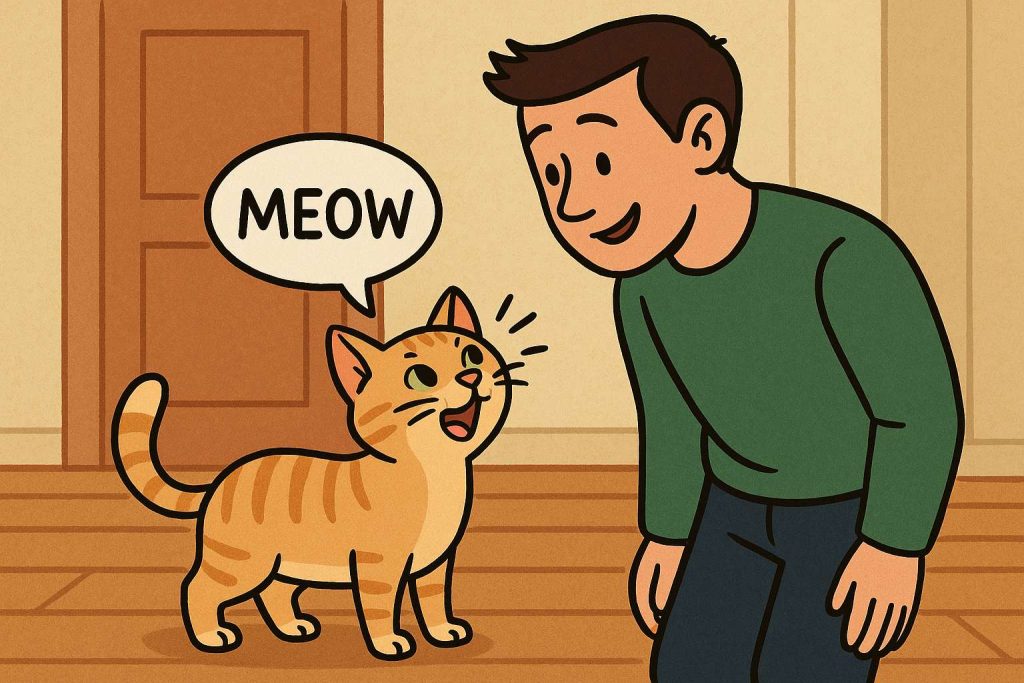
When they looked at the videos, one pattern jumped out. On average, cats meowed 4.3 times in those 100 seconds when a male caregiver walked in, and 1.8 times when a female caregiver came home. That is a pretty big gap for such a short moment.
What the team actually looked at
The scientists did not only count meows. They created a list of 22 different behaviors to track. They watched tail position, ear movements, rubbing, stretching, yawning, purring and other types of sounds. They checked how quickly the cat approached and how close it stayed to the person.
Almost everything looked similar for men and women. Cats walked to the door, raised their tails, rubbed against legs and showed relaxed, friendly body language in both cases. The overall warmth of the greeting did not change. The only thing that clearly shifted was how often the cats used their voices.
With male owners, cats seemed to lean more on sound. They used more meows and little chirps during that first minute or so. With female owners, they still greeted them nicely. They just did not feel the need to be quite as loud.
Why would cats meow more to male owners
The next question is the obvious one. Why. The researchers tried to see if something about the cats themselves could explain it. They looked at age, sex and breed. They also thought about household details, like how many people lived there. None of these things changed the main result. No matter how they sliced the data, cats still vocalized more toward men during greetings.
So they turned their attention to the humans. Earlier research suggests that women often talk more to their pets and respond more quickly to small cues. A tiny tail flick or a soft brush against the leg may be enough for a woman to notice and react. Many men, on average, talk a bit less and may wait for clearer signals before engaging.
If a person tends to wait for stronger cues, the cat learns to give stronger cues. Over time, the cat figures out what works best with each member of the family. With a male caregiver, louder and more frequent meows might be the most efficient way to be heard. If those meows reliably bring eye contact, food or petting, the pattern sticks.
It is not that cats somehow “like” men more or less. It is more likely that they have learned how to press the right buttons for each person.
What this tells us about cat communication
Meowing is special because adult cats rarely use it with each other. They rely more on body language and scent in cat to cat communication. Meows are mainly for us. Over time, these sounds turn into a flexible toolkit. A cat can use them to say “I am hungry”, “I missed you”, “Come here” or even “I am annoyed”.
This study adds a small but interesting piece to the picture. It shows that cats do not have one fixed way of using their voice. They adjust how often they meow depending on who is standing in front of them. When a man comes home, they tend to go a bit heavier on sound. When a woman comes home, quieter signals can be enough.
If you also share your home with a dog and you are in those first weeks of getting to know each other, you might enjoy the gentle 7-7-7 rule for new dog owners, which explains how dogs often settle in over time. It is another nice reminder that our pets are always adjusting to us and our routines.
What it might mean in your home
If you are a male cat owner and your cat seems extra noisy when you walk through the door, this study offers a kind explanation. Your cat may simply have learned that you respond best when it “speaks up”. Those repeated meows are not random. They are part of a communication style that you and your cat built together.
If you are a female owner and your cat greets you more quietly, that is not a bad sign at all. Fewer meows do not mean less love. It could mean your cat feels confident that you will notice the small things. A gentle brush against your leg or a calm look might be enough to get your attention.
Of course, this was a small study from one country. Daily routines, housing styles and cultural habits vary a lot. Bigger studies in different places will help us see how general this pattern really is. Still, the findings match what many cat owners feel in their day to day life. Cats watch us closely. They learn our habits. Then they adjust their own behavior to get what they need.
In the end, that might be the sweetest part of the story. If cats meow more to male owners, it is not a random quirk. It is proof that our pets are paying attention and trying their best to talk to us in a way we understand.