

















Pets fill a home with joy. They also bring steady, sometimes messy bills. Food, vaccines, grooming, toys, and sudden vet visits stack up fast. Many owners only see the full cost when a bank statement arrives.
A clear money plan helps a lot. The 50/30/20 rule is a simple way to shape a budget. It splits money into three parts. Half goes to needs, part goes to wants, and the rest goes to savings. You can use the same frame for your pet and turn scattered spending into a calm monthly plan.
Once you treat pet costs as their own mini budget, everything feels clearer. You see how much feeds your pet and keeps it healthy. You notice how much flows into fun extras. You also build a safety net for the big, scary bills that may appear one day.
This guide explains the 50/30/20 rule, shows how it works for pets, and gives real examples. The goal is simple. You keep your pet covered, and you protect your wallet at the same time.
What the 50/30/20 rule means
The classic 50/30/20 rule uses three buckets of money.
- 50% for needs
- 30% for wants
- 20% for savings and debt goals
Needs include rent or mortgage, basic food, power, transport, and minimum debt payments. These keep a household stable.
Wants cover extras that make life nicer. Think eating out, treats, hobbies, and trips. Life feels flat without them, yet you can cut them in a tight month.
Savings and debt goals build future safety. This bucket holds your emergency fund, long-term savings, and extra payments on loans.
People like this rule since it is easy to remember and quick to use. You only need your monthly net income and a basic list of costs.
For pets, the idea is the same. You give your pet budget three buckets. Then you decide which pet costs are needs, which are wants, and which feed long-term protection.
You can set a pet share of your income and split it 50/30/20. Or you can take your current pet spending and gently steer it toward those ratios over time. Both paths work.
Turning 50/30/20 into a pet budget
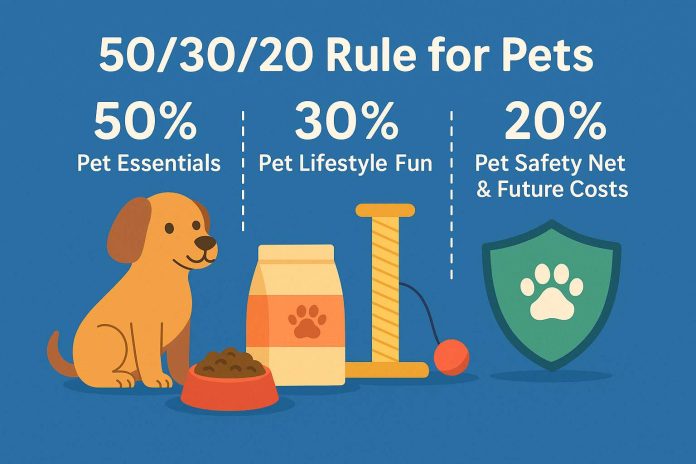
For a pet, the three buckets look like this.
- 50%. Pet essentials (needs)
- 30%. Pet lifestyle and fun (wants)
- 20%. Pet safety net and future costs (savings)
This setup works for dogs, cats, and many small pets. The numbers change with size, age, health, and local prices. The structure stays helpful in most homes.
1. The 50% pet essentials bucket
This bucket holds everything your pet needs for health and basic comfort. If you cut too deep here, your pet’s wellbeing may suffer.
Common items in the essentials bucket:
- Main pet food and any required prescription diet
- Fresh water and litter for cats or small pets
- Routine vet visits and vaccines
- Parasite and worm prevention as your vet recommends
- Regular medication for ongoing conditions
- Basic grooming that prevents pain, such as coat care and nail trims
- Pet license or registration where needed
- Microchip and ID tags
- Core gear such as collar, harness, leash, crate, or carrier
For a large dog, this bucket will be bigger. Food and medication cost more for big bodies. For a small indoor cat, this share is usually lower. Senior pets often move the essentials bucket up as medical needs grow.
The 50% mark does not tell you to cut real care. It reminds you to check the rest of your budget so you can support this part without stress.
2. The 30% pet lifestyle and fun bucket
The second bucket covers extras that make life richer. These things matter for happiness, yet your pet could live without them for a short time.
Typical items in the wants bucket:
- Extra toys beyond basic play and mental work
- Decorative beds, themed bowls, and stylish crates
- Clothing and seasonal costumes
- Fancy treats that go beyond simple training snacks
- Spa-style grooming, bows, special shampoos, and perfume
- Luxury daycare, dog camps, or pet hotels
- Professional photo shoots
- Monthly subscription boxes full of toys and snacks
This bucket can grow fast without a plan. Small impulse buys feel cheap in the moment. Over a year, they form a big stack. The 30% limit keeps wants fun but contained.
3. The 20% pet safety net bucket
The third bucket is your quiet shield against bad days. It is the heart of the 50/30/20 rule for pets.
Use it for:
- A pet emergency savings fund
- Pet insurance premiums if you choose a policy
- Future dental work that needs anesthesia
- Surgery, imaging, or long-term treatment
- End-of-life care when that time comes
Vet emergencies often cost far more than a regular visit. A single night in a clinic may run into four figures. A steady savings habit turns random fear into a controlled plan. You accept that hard days can appear, and you build a cushion in advance.
Step-by-step. How to build your pet 50/30/20 budget
Step 1. Track what you spend now
First, gather a clear picture. Look at your pet costs for the last three months. You can use banking apps, card records, and old receipts. Then write down every pet item.
Include:
- Food and litter
- Treats
- Vet visits and vaccines
- Medication and preventive products
- Grooming
- Toys, beds, scratching posts
- Training classes
- Boarding, daycare, and pet sitters
- Insurance premiums
Next, add the totals for each month. Add the three monthly totals together and divide by three. That number is your average monthly pet spending.
Many owners feel surprised at this step. That feeling is normal. The goal is not blame. The goal is a clear view of reality.
If your pet is new, you may not have three full months to study. In that case, talk with your vet and ask for a rough yearly cost for a healthy pet of the same type. Then divide that number by twelve and use it as a starting point.
Step 2. Decide how much of your income goes to pets
Now decide how large your pet budget should be. Some people treat pet spending as part of the main “needs” bucket in their household 50/30/20 plan. Others prefer a separate pet line. Both styles can work.
Look at your current pet total from step one and compare it with your income. Then think about rent, food, loans, and human savings goals. A pet budget should feel fair for your animal and still safe for the rest of your life.
In many homes, pet costs sit somewhere between a small slice and a modest slice of household income. Chronic illness, special diets, and high local vet prices can push beyond that. The key point is that you pick a clear number and write it down.
Choose a monthly pet budget that you can keep for at least six months. That gives the plan time to settle.
Step 3. Split that pet budget into 50/30/20
Now apply the rule to your chosen pet number.
For example, say you set a pet budget of 200 euros each month. The split will look like this.
- Needs. 100 euros
- Wants. 60 euros
- Savings. 40 euros
If your budget is 100 euros, the split becomes 50 euros for needs, 30 euros for wants, and 20 euros for savings. The math always follows the same pattern.
Write these three figures in a place you see often. They are the new guardrails for pet spending.
Step 4. Place each expense in the right bucket
Next, take your list from step one and sort every cost into a bucket.
- Needs hold food, litter, routine vet care, prevention, ongoing medication, and core gear.
- Wants hold extra toys, fancy beds, luxury treats, fun outfits, and spa grooming.
- Savings hold insurance premiums and any money you move into a pet savings account.
Then compare the real numbers with the ideal 50/30/20 split. You may notice that needs take more than half. You may see that wants creep over a third. You may find that savings sit at zero.
That gap becomes your guide for the next few months. You can shop around for better prices under your vet’s advice. You can trim impulse extras. You can move part of your wants budget into savings until your safety net feels strong.
Sample 50/30/20 pet budgets
Prices change from one country to another. Vets in big cities often charge more than vets in small towns. The next examples use simple, rounded numbers to show how the rule works in real life.
Example 1. Adult mid-size dog
Imagine this monthly pattern.
- Dog food. 40 euros
- Routine vet care, averaged across the year. 30 euros
- Flea, tick, and worm prevention. 15 euros
- Basic grooming and nail trims. 10 euros
- Toys and basic treats. 20 euros
- Occasional daycare or boarding. 15 euros
Total pet spending. 130 euros per month
The pure 50/30/20 split for 130 euros would be:
- Needs. 65 euros
- Wants. 39 euros
- Savings. 26 euros
Now compare the plan with the example costs. In this list, needs already reach about 95 euros. Wants sit near 35 euros. Savings are at zero. The rule and the reality do not match.
You have a few clear options.
You can raise the whole dog budget and keep the rule. You can trim some wants and drop food or grooming costs with smart swaps. You can blend both ideas and move a slice of current wants into savings.
For instance, you could lift the budget to 150 euros. Then the rule gives 75 euros for needs, 45 euros for wants, and 30 euros for savings. The next step is to lower needs closer to 75 euros with safe changes. You might buy food in larger bags at a better price. You might combine services at the vet during one visit. At the same time, you set a fixed 30 euro transfer to a dog emergency fund every month.
Example 2. Indoor cat
Now picture a typical indoor cat.
- Cat food. 25 euros
- Litter. 15 euros
- Routine vet care across the year. 20 euros
- Flea and worm prevention. 10 euros
- Toys and treats. 10 euros
Total pet spending. 80 euros per month
The 50/30/20 split gives:
- Needs. 40 euros
- Wants. 24 euros
- Savings. 16 euros
In the sample list, needs and litter already reach about 70 euros. Wants sit at 10 euros. Savings are still zero. The pattern shows that this owner looks after the cat’s main care but has no cushion yet.
One path is to raise the total budget slightly, perhaps to 90 or 100 euros. Another is to hold the total and free a small slice from needs with better deals. Then the owner can start a steady savings transfer of at least 16 euros each month.
Example 3. Small pet such as a rabbit or guinea pig
Small pets often look cheap at first glance. Yet their care can grow due to hay, bedding, and specialist vet care.
Imagine this pattern.
- Hay, pellets, and fresh greens. 30 euros
- Bedding. 10 euros
- Routine vet care averaged across the year. 10 euros
- Toys and chews. 10 euros
Total pet spending. 60 euros per month
The 50/30/20 split gives:
- Needs. 30 euros
- Wants. 18 euros
- Savings. 12 euros
In this case, most of the money already goes to food and bedding. You may not hit the exact ratios. You still gain from the safety net habit. A 10 or 12 euro transfer each month builds a fund for trips to exotic vets, which often cost more than standard clinics.
How large should your pet emergency fund be?
The 50/30/20 rule tells you how to split new money each month. It does not set a final size for the savings pot. You choose that part.
Many owners pick one of these goals.
- One full year of routine pet costs.
- Enough cash to handle one serious emergency.
You can start with a small first step. For example, you could aim for 500 euros. Once you reach that, you could move the line to 1,000 euros or another level that fits typical emergency care in your area.
If your pet has ongoing medical needs, you may feel better with a larger fund. In that case, you can adjust the split for a while. You might run 60% needs, 20% wants, and 20% savings. You might even try 50% needs, 10% wants, and 40% savings until the fund looks solid.
The main idea is that you decide on purpose, not in a rush after a crisis starts.
Where pet insurance fits in the 50/30/20 rule
Pet insurance turns rare, large bills into steady monthly premiums. It can help many families sleep better. In a 50/30/20 pet budget, it fits in two places.
- The monthly premium sits in the needs bucket.
- The savings bucket covers your deductible and your share of each claim.
First, look at several policy offers. Then compare the monthly price, the deductible, and the pay-out rules with vet prices in your region. A basic policy may cover only accidents and major illness. A richer plan may include routine care or dental cleaning.
If you choose a policy, add the premium to your needs list and keep the savings habit in place. Insurance rarely pays 100% of a bill. Cash savings still fill the gaps. Together they form a stronger shield.
If you prefer not to use insurance, you can treat your savings bucket as a self-funded safety net instead. In that case, you may want to grow it faster and hold a larger balance before you relax the pace.
Keeping each bucket under control
Keeping needs realistic without cutting care
You should not downgrade care or food just to hit a ratio. You can still tidy this bucket with smart choices.
For example, you can compare food prices per kilo instead of by bag. You can buy sturdy leashes and bowls once, not flimsy ones many times. You can ask your vet whether safe generic drugs exist for a given treatment. You can plan routine visits so that vaccines, checkups, and lab work often fall on the same day.
Small moves like this keep quality the same and still free room in your budget. That extra space can feed your savings bucket or leave a little more for wants.
Keeping wants fun but balanced
The wants bucket should feel friendly, not guilty. Pets need play, comfort, and bonding. The aim is balance.
You can keep wants in line with a few habits.
- Set a simple monthly limit for toys and special treats.
- Rotate toys so old ones feel new again.
- Use low-cost games, like cardboard box puzzles or homemade snuffle mats made from safe materials.
- Plan seasonal items, such as winter coats for small dogs, ahead of time inside the wants bucket.
Once you track wants as a clear number, patterns appear quickly. One extra treat bag or toy every few days may seem small. Over a year, it becomes a large share of the pet budget.
Building savings on autopilot
The savings bucket works best when it runs almost on its own.
You can open a separate savings account for pet costs and name it after your pet. Then you can set an automatic transfer of the 20% share each month, right after your income arrives.
Next, you can check the balance once per month. Mark milestones such as 250, 500, and 1,000 euros. Each step means more safety for your pet’s future care and more peace of mind for you.
If you are a new pet parent and you want a wider view of safety habits, you can read this complete beginner’s guide to pet safety and pair it with your new budget. That way, your money plan and your daily routines support each other.
Common mistakes this rule helps avoid
A clear frame prevents many problems that pet owners face. Here are some frequent traps and how the 50/30/20 rule for pets reduces the risk.
1. Ignoring long-term vet care
Many new owners plan for food and a collar, then forget vaccines, blood tests, and dental care. A fixed needs bucket pushes you to include health from day one instead of reacting later.
2. Having no plan for emergencies
Without a pet safety net, a single surgery can lead to heavy debt or heartbreaking choices. The 20% savings share creates a growing fund, even if you start small.
3. Mixing wants with needs
It is easy to label luxury treats and decor as “needed” once you love your pet. With three buckets, you can see which items truly protect health and which items just add charm. That view makes it easier to cut back on extras without guilt.
4. Adding pets without fresh math
A second pet often brings more than “a bit extra” in cost. Vet visits, food, and boarding usually double. The 50/30/20 rule reminds you to make a new plan each time the family grows.
5. Forgetting that pets age
Puppies and kittens grow into adults and then into seniors. Their medical needs change along the way. A savings bucket that starts early acts like a soft landing for those later years.
When you bring a new dog home, you also manage a big emotional change for the animal. The simple 3-3-3 method for dogs explains how dogs adjust in the first days, weeks, and months. If you combine that method with a clear budget, you support both the mind and the body of your new friend.
Does every owner need the exact 50/30/20 split?
Not every home fits the classic ratios. Some owners earn more and have low pet costs, so they spend a bigger share on wants. Others care for pets with complex medical needs and push more money into essentials and savings.
The value of the 50/30/20 rule for pets sits in the structure. You gain three clear groups and a simple target. Then you adjust the numbers to match your life.
You can try 60% needs, 20% wants, and 20% savings for a few months. You can move to 40% needs, 30% wants, and 30% savings after a pay raise. The buckets do not change. Your choices inside them do.
What matters most is that health care and savings have their own space. Your pet gets the food, shelter, and treatment it needs. You get fewer money shocks and more calm when hard days arrive.
Key points to keep in mind
- Pet costs include food, vet care, prevention, and many extras.
- The 50/30/20 rule gives a clear, simple frame for any budget.
- For pets, 50% goes to essentials, 30% to lifestyle and fun, 20% to a safety net.
- You start by tracking real costs, then shape them into three buckets.
- A steady savings habit builds an emergency fund and prepares you for aging or sick pets.
With a small amount of planning, you gain a lot of peace. The 50/30/20 rule for pets turns random spending into a calm, written plan. Your pet stays covered, and you feel ready for both ordinary days and harder ones.