The “25% rule” sounds like a feeding trick. Still, on cat food packages, it is a label naming rule. It tells you what a front-label word like “dinner” can legally mean.
So if you have ever picked up a can that says “Chicken Dinner,” this guide clears it up. Then you can shop faster, and you can feel more confident about what you are buying.
What the 25% rule means
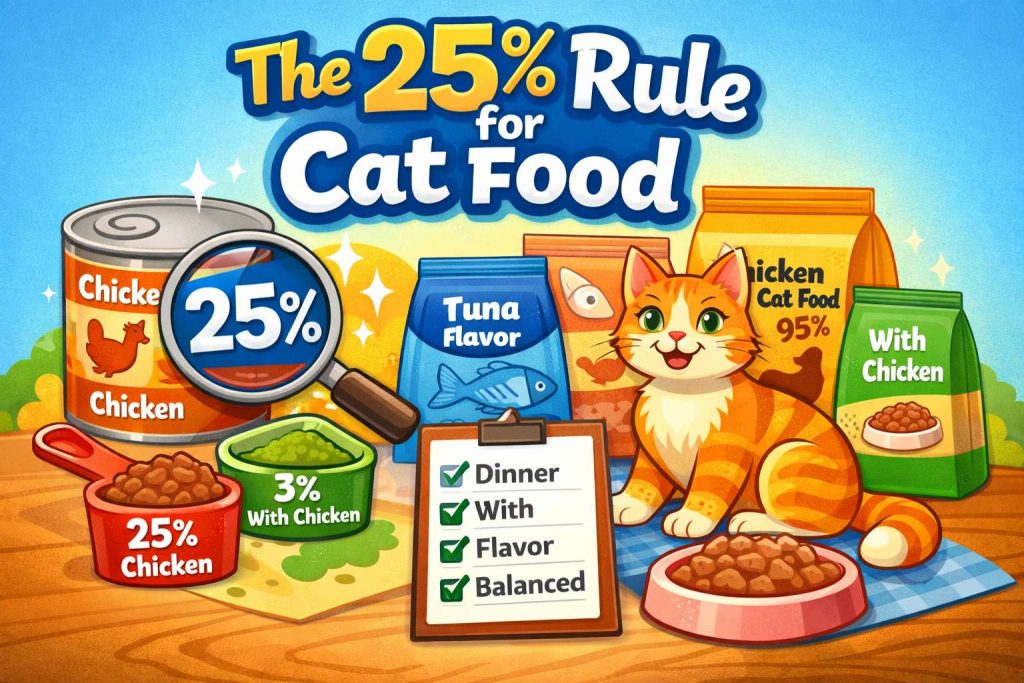
The 25% rule applies when the product name uses a descriptive word like dinner, entrée, platter, recipe, or formula next to a named ingredient.
To use that kind of name, the food must meet two minimums:
- The named ingredient is at least 10% of the total product by weight.
- The named ingredient is at least 25% by weight after you exclude added water used for processing.
So a wet food can still say “Chicken Dinner” even when it looks very moist. Added water changes how that second number is calculated.
Why “dinner” can confuse shoppers
“Chicken Dinner” does not mean the food is 25% protein. It does not mean the food is “mostly chicken,” either. It only means the chicken meets the naming minimum tied to that style of product name.
So what does “Chicken Dinner” really promise? It promises a minimum amount of chicken under that naming rule, and nothing more.
That is why the product name is only step one. Next you check the rest of the label, then you decide if it fits your cat.
Words that often signal the 25% rule
You can spot this rule quickly. Look for these words on the front label:
- Dinner
- Entrée
- Platter
- Recipe
- Formula
For example, “Turkey Entrée” and “Salmon Recipe” often fall under the same naming standard as “Chicken Dinner.”
When the name lists two or more ingredients
Some names list more than one ingredient, like “Chicken and Rice Dinner.” That can still fit the 25% rule. There is a second minimum to know:
- When more than one ingredient is named, each named ingredient must be at least 3% of the total product by weight.
Then there is the name order. The ingredient listed first should appear in a larger amount than the next one listed. So “Chicken and Rice Dinner” should contain more chicken than rice.
Other label rules you will see in the same aisle
The 25% rule makes more sense once you compare it to the other common name rules. Then the front label stops feeling like guesswork.
The 95% rule
A plain name like “Chicken Cat Food” signals a much higher ingredient level than “Chicken Dinner.” In many cases, that name style means the named ingredients make up most of the product after you exclude added water.
So a simple name can be a stronger clue than a fancy name.
The “with” rule
A name like “Cat Food with Chicken” sets a lower bar than “Chicken Dinner.” “With” can mean the named ingredient is present at 3% by weight.
So if chicken is a priority for you, “with chicken” is not the same as “chicken dinner.”
The flavor rule
A name like “Chicken Flavor” does not follow a fixed percent like the 25% rule. Instead, the flavor source only needs to be present in an amount that creates the flavor profile.
So “flavor” tells you the least about the actual ingredient level.
How to use the 25% rule when buying cat food
The front label gives you a clue. Still, the full label tells you if the food fits daily feeding.
Start with the nutrition adequacy statement
Look for language that says the food is “complete and balanced” for a life stage, like growth, adult maintenance, or all life stages.
Then watch for “intermittent or supplementary feeding only.” That line signals a food meant as a topper or treat-style meal, not a full daily diet.
Then scan the ingredient list with a simple goal
Ingredients list in descending order by weight. So you can compare two similar foods quickly.
Use the list to answer direct questions:
- Is the named meat near the top, or far down the list?
- Do the animal ingredients look clear, or vague?
- Does the recipe fit your cat’s needs and sensitivities?
The list still does not show exact percentages for each ingredient. So treat it as a ranking, not a recipe card.
Next, use the guaranteed analysis as a rough check
The guaranteed analysis lists minimums and maximums for crude protein, crude fat, crude fiber, and moisture. It is a quick comparison tool, especially within the same food type.
Wet foods carry more moisture than dry foods. So the protein percent can look lower on wet food labels. That is normal. So compare foods with the whole label in mind, not one number.
Common misunderstandings that waste time in stores
“Chicken Dinner” means it is mostly chicken.
No. The name only confirms the naming minimum.
The 25% rule proves quality.
No. It checks the name claim, not the full formula. Your cat’s health, body condition, and stool quality tell you far more over time.
“With Chicken” and “Chicken Dinner” mean the same thing.
No. “With” can mean 3%. “Dinner” points to the 25% naming standard with the added-water rule.
Two quick reads that help with smarter pet choices
If you like clear, practical label talk, this overview of recalls and label changes is worth a look: 2025 pet food review with recalls, label updates, and nutrition rules.
And if you enjoy pet trends too, this roundup is a fun one: pet names that keep climbing in 2025.
Fast label checklist
Use this quick checklist in the aisle:
- Read the product name and spot key words like dinner, with, or flavor.
- Match that word to what it implies about the named ingredient level.
- Confirm the food is complete and balanced for the right life stage.
- Compare ingredient lists across similar products.
- Track your cat’s weight, coat, appetite, and litter box changes after any switch.