
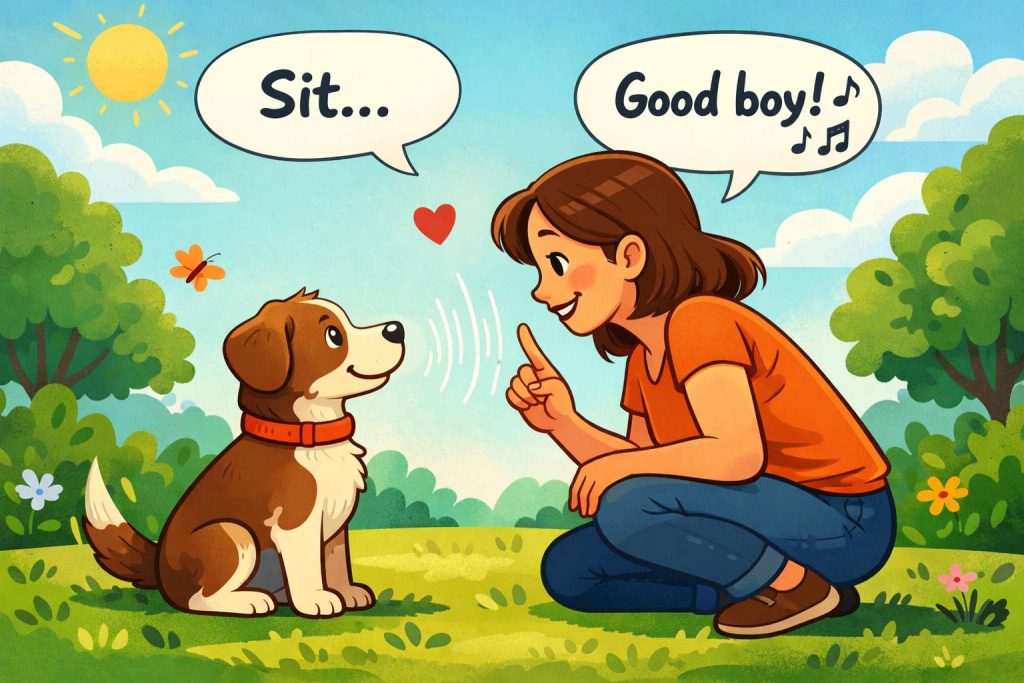
If you’ve ever caught yourself using a soft “baby voice” with your dog, you’re not alone. Most people do it without even noticing. And it turns out that instinct is not silly at all. There’s real science behind it.
The main takeaway is surprisingly simple. Your dog listens better when you slow down.
It sounds almost too easy, right? But it matches what researchers keep finding about how dogs process sound. Dogs pick up speech in a different rhythm than humans do. So when we talk fast, they can lose the key word, even if our tone sounds friendly.
Slower speech fits a dog’s natural timing
In a 2024 study in PLOS Biology, Déaux and colleagues compared how dogs vocalize with how humans speak. Then they looked at the way people naturally talk to dogs.
Here’s what they found:
- Dogs make sounds at about 2 sounds per second
- Normal adult speech sits around 4 syllables per second
- Dog-directed speech usually lands near 3 syllables per second
So without training or thinking about it, most of us already slow down when we talk to dogs. And that pacing may help dogs “lock in” to what we’re saying. It gives them a clearer pattern to follow.
Dogs catch the beat of your words
A lot of dog training advice focuses on tone and energy. That matters, yes. But rhythm matters too.
Humans can handle faster speech and still keep meaning. Dogs often need a steadier pace to separate words cleanly. When you rush, the command can blend into the rest of the sentence, and your dog ends up guessing what you wanted.
If you want your dog to follow you faster, aim for this:
- Use fewer words
- Leave small gaps
- Keep your pace steady
It feels simple, but it works well in day-to-day life.
Pitch helps, but it’s not the whole story
People love using a higher voice with dogs. You know the one. Big smile, upbeat tone, almost like you’re talking to a toddler.
That style can pull attention fast, especially with puppies. In a 2017 study in Proceedings of the Royal Society B, Ben-Aderet and colleagues found puppies were highly reactive to dog-directed speech, with pitch a key factor. Older dogs in the same study did not react any differently to dog-directed speech than to normal speech.
So yes, a warm tone helps. But speed and clarity carry the message.
Dogs can still understand you without the “happy voice”
A lot of owners believe dogs only react to emotion in speech. Newer research keeps pushing back on that idea.
Dogs can pick out meaning from words, even when the voice sounds flat. University of Sussex researchers reported in Animal Cognition in 2025 that dogs spot words and phrases that are meaningful to them, such as their name, even when the speaker uses a dull, monotonous tone. The voice doesn’t need to sound excited for the dog to catch the important part.
That’s good news. It means your dog is not only listening to your mood. They’re listening to the pattern, the cue, and the timing.
The best way to talk to your dog in real life
You don’t need to change your personality or talk like a trainer on TV. You just need a cleaner routine. Here’s an easy script that works well at home.
Say the name once
Use your dog’s name to grab attention. Then stop. Repeating it again and again turns it into background noise.
Pause for a moment
Half a second is enough. That tiny break helps your dog “reset” and get ready for the cue.
Give one short command
Keep it tight: “Sit.” “Come.” “Down.” “Stay.”
One cue word beats a full sentence almost every time.
Keep the same tempo each time
Dogs love patterns. When your timing stays steady, your dog learns faster.
Use a warm, calm voice
Friendly wins. Shouting often adds stress, and stress makes focus worse.
If your dog struggles with listening, try this for a full day. Slow down more than feels natural. It can feel weird at first, but you’ll get used to it fast.
Common talking habits that confuse dogs
Even smart, well-trained dogs get stuck when we do these things:
- Long speeches that hide the command
- Rapid repeats like “sit sit sit sit”
- Switching cue words every time
- Giving the cue while your dog is already walking away
Fixing the speed alone can make a big difference. Your dog gets a cleaner signal. You get a quicker response.
A quick checklist you can use today
If you want a simple rule you can remember without thinking, this is it:
- Slow down
- Say less
- Leave small pauses
- Use the same cue word every time
- Pair the cue with the same hand signal
Dogs learn through repetition, timing, and reward. Your voice sets the stage, then your consistency does the rest.
And hey, if you’re a multi-pet household, this idea carries over in a fun way. Cats also respond better to clear cues and the right timing. If you want a quick example, check out this guide: Hands first, voice second: the cat calling trick that gets real results.
Talk slower, keep it simple, and give your dog a clean moment to respond. You’ll start noticing the difference pretty quickly.