Check your freezer before the next meal if your cat eats Darwin’s raw chicken food. The FDA said on October 26 that two lots of Darwin’s Natural Selections Chicken Recipe for Cats tested positive for Salmonella. The company hasn’t started an adequate recall, so finding the packs is up to you.
These are the two lots:
- Lot 12731, made on July 8, 2026
- Lot 12493, made on April 2, 2026
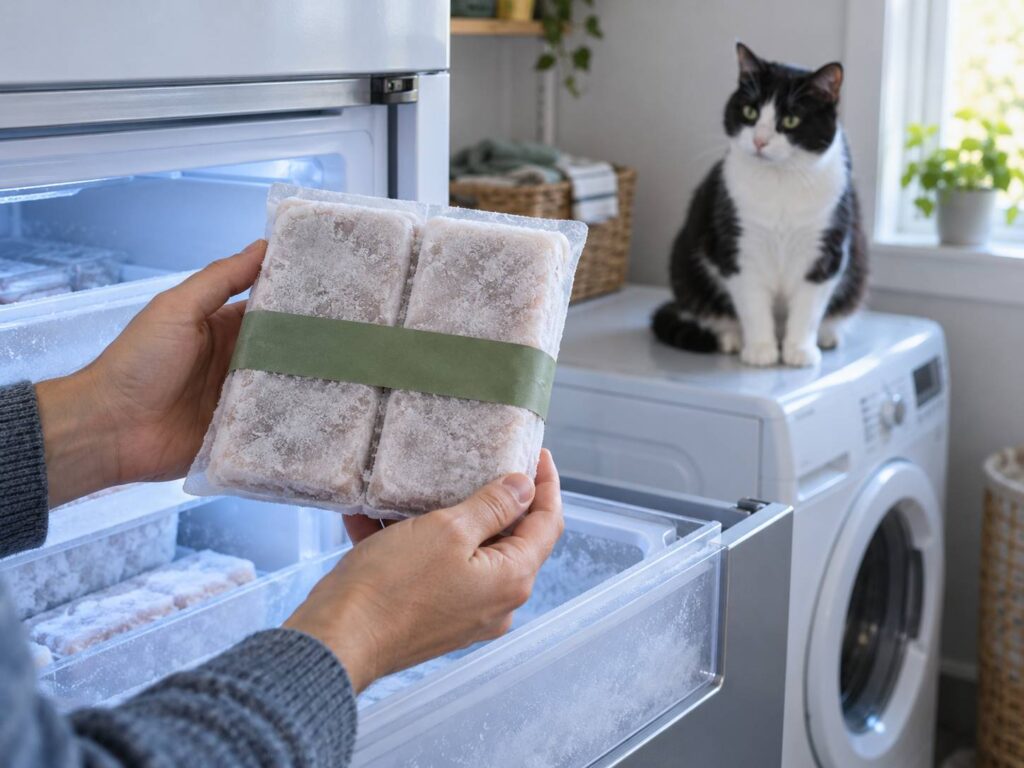
Each frozen 2-pound pack is white and clear plastic with green and black labeling, split into four units. The lot code is printed on the front of the lower left unit. Matching that number, not the brand name, is how you check pet food against a recall, and it works the same way for an FDA advisory.
Why the April lot may still be in your freezer
Darwin’s sells its food online by subscription, and the packages carry no expiration date. A pack from April can sit frozen for months between deliveries. Freezing doesn’t kill Salmonella, so time in the freezer doesn’t make that pack safe.
If the lower left unit is already used, or its code is too worn to read, throw the food away. The advisory names only those two lots.
Two sick cats behind the testing
The agency tested the food after an owner complained about two cats that got gastrointestinal illness after eating Darwin’s chicken recipe. One was hospitalized. It had eaten from one of the two lots, and both cats recovered once they stopped eating the food.
No recall from Darwin’s
The FDA recommended that Arrow Reliance, the company that does business as Darwin’s, recall both lots. By October 26, no adequate recall had begun.
A federal complaint filed against the company on August 7 says Darwin’s turned down FDA recall requests every year from 2022 to 2025. It also looks at the most recent FDA samples of Darwin’s food, collected since 2023. Twelve of the 18 contained disease-causing bacteria.
In an October 13 statement, Darwin’s says it contacts affected customers directly instead. It offers to replace their food and calls that the same function as a recall.
That statement predates the advisory, so it doesn’t say whether the households that received these two lots were contacted. Check the code yourself. If your order history doesn’t show which lots you got, call Darwin’s at 877-738-6325.
If a pack matches
- Stop feeding it. Throw it away in a secure container that pets and wildlife can’t get into, and don’t donate it.
- Clean and disinfect everything the food or your cat touched: bowls, storage containers, utensils, prep surfaces, bedding, toys, floors and the freezer shelf.
- Scoop the litter box promptly, and pick up feces anywhere your cat goes outdoors.
- Wash your hands after handling the food, the litter or anything that touched them.
Signs to watch in your cat, and in you
When a cat does show signs of Salmonella, the FDA lists vomiting, diarrhea that may be bloody, fever, loss of appetite and lower activity. Call your vet promptly if you see any of them.
A cat with no signs can still carry the bacteria and shed it in its feces and saliva. That’s how it can reach people, who may get diarrhea, fever and stomach cramps. The very young, the very old and people with weak immune systems face the most risk, and anyone with symptoms should see a doctor.
The government’s complaint describes a four-year-old who fell ill in August 2024 after the family dog was fed Darwin’s food. The child caught a Shiga toxin-producing strain of E. coli and developed hemolytic uremic syndrome, a complication that damages the kidneys.
FDA records cited in the complaint show 49 complaints from owners about pets sickened by Darwin’s food from 2016 through January 2026. Those complaints reported 35 sick cats, and four were reported to have died. Darwin’s says the evidence doesn’t show its food caused the illnesses the FDA cites.
What the court case decides
The lawsuit, in federal court in Seattle, asks a judge to require sanitation fixes before Darwin’s makes or ships more pet food. Its claims are allegations the government still has to prove. Darwin’s filed its response on September 16. It doesn’t dispute the FDA’s past inspection findings, only the conclusions drawn from them.
Until a judge rules, FDA advisories like this one are where affected Darwin’s lot numbers become public.