If a coyote approaches you and your dog, don't run. Shorten the leash, shield your dog, get big and loud, and back away while you keep facing it. That routine is called hazing: scaring the animal off without hurting it. Some hazing advice says to walk at the coyote or chase it. We wouldn't do that with a dog on the leash, because it takes your dog toward the animal you're protecting it from.
This guide draws on US wildlife-agency advice for an encounter during a dog walk. Follow any local wildlife restrictions and reporting instructions as well.
Before your next walk
Have these ready before you need them:
- A short, non-retractable leash. Colorado recommends a short leash. University of Florida extension recommends a fixed-length leash.
- A noisemaker in your pocket: a small air horn, a whistle, or a sealed can with pennies inside.
- A current rabies vaccination, with the certificate date written down.
- Your state wildlife agency and local animal control numbers saved in your phone.
A pocket-sized air horn is a practical option listed by Massachusetts and Colorado. Keep control of the leash before using a noisemaker, because the sound may startle your dog too. Carrying one does not replace keeping your dog close.
Stay away from known den sites and thick brush, and take extra care at dawn and dusk. If coyotes live near you, Washington's advice is to avoid early morning and late evening walks altogether.
Massachusetts warns of greater aggression toward dogs during mating and denning seasons, from January through May. Keep dogs leashed and directly supervised throughout the year, especially around dawn and dusk.
Read the coyote first
A coyote may watch you and your dog while making sure you leave its territory, according to Massachusetts. California recommends keeping a safe distance and allowing it to leave. A sighting alone is not a reason to approach the animal.
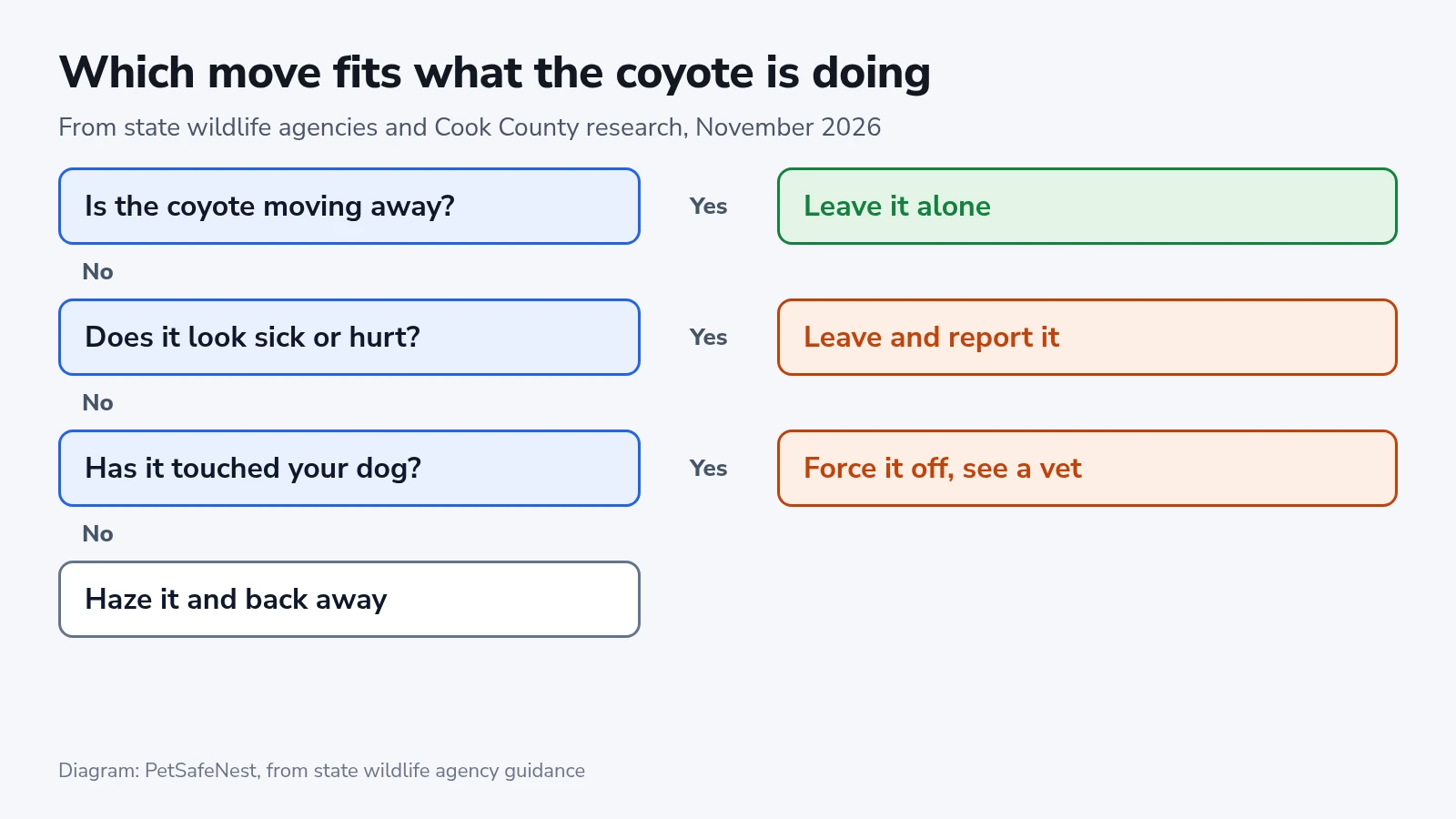
Leave a sick or injured coyote alone and contact local animal control or your wildlife agency. Colorado lists raised hackles, bared teeth and growling as signs of aggression. Do not move closer to investigate.
The six moves when it stays or comes closer
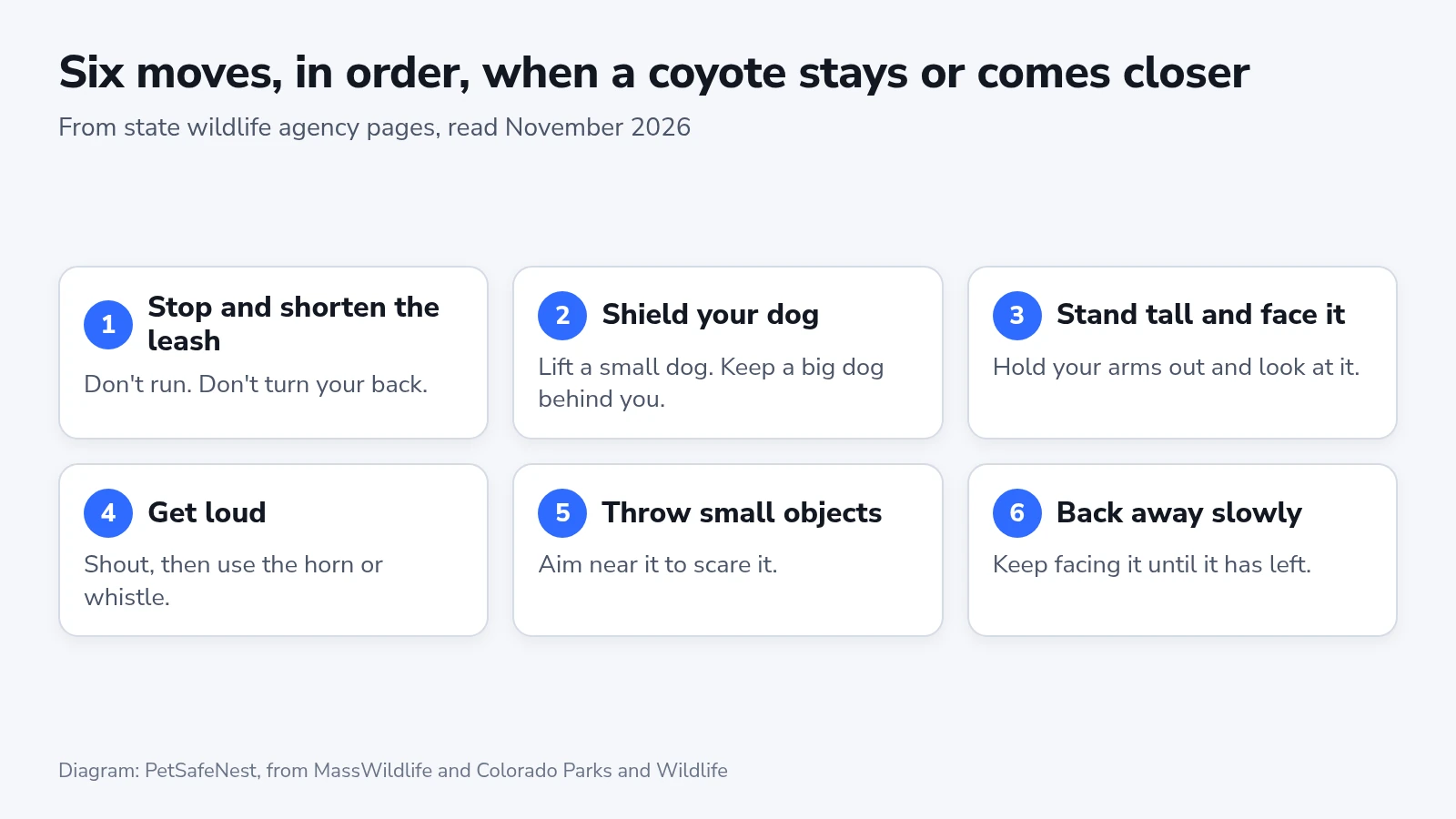
- Stop and shorten the leash. Don't run, and don't turn your back.
- Shield your dog. Lift a small dog if you can, and keep a big dog behind you.
- Stand tall and face it. Hold your arms out to look larger, and look at the coyote.
- Get loud. Shout "Go away, coyote" in a firm voice, then use the horn or whistle. Grip the leash first, because a sudden blast can startle your dog too.
- Throw small objects. Sticks or small stones landing near it are enough, because the aim is to scare it.
- Back away slowly. Keep facing it and keep making noise until it has left the area.
If it pauses nearby, keep your dog close and continue backing away while facing it. Do not follow it into brush or toward a den.
Lift a small dog early, while the coyote is still keeping its distance. University of Florida extension says picking up your dog may be safe unless the coyote becomes aggressive. Once it's lunging, keep making noise and move away with your dog.
Why you back away with a dog on the leash
Massachusetts tells owners to get the pet inside if possible, then return outside to haze the coyote. Colorado says to face a coyote that will not leave and slowly back away. California also advises backing away slowly while keeping pets close.
On a dog walk, backing away keeps your pet moving away from the encounter. We would follow that route instead of walking toward the coyote with the dog still beside us.
If your pet is safely inside, Massachusetts advises returning outside to haze the coyote. Stay back from it and leave it a route away.
If the coyote touches your dog
California’s Department of Fish and Wildlife says to fight back if a coyote makes contact, then call Animal Control or 911. That is an emergency response to contact, not an instruction to approach or chase a coyote. Protect yourself while getting your dog away from the encounter.
Once the coyote is gone:
- Move your dog away from the spot and look for bites and scratches.
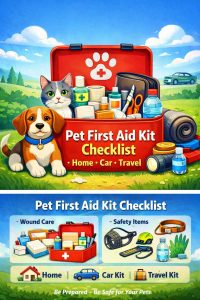
- Scrub any wound with soap and water, then flush it well with tap water. Washington gives those steps for people and says to do the same for a pet. A pet first aid kit has gauze and wrap for the ride.
- Call your vet right away, even if you can't find a wound. Any pet attacked by wildlife should be evaluated by a vet.
- Take the rabies certificate with you.
- If you were bitten or scratched, wash the wound the same way, then call your doctor and your local health department. Call 911 if a person is hurt.
- Report the attack.
A veterinarian should evaluate any pet attacked by wildlife, even if injuries are hard to see. A public health official assesses possible rabies exposure. Do not use the animal’s appearance or a population statistic to decide that treatment is unnecessary.
After a confirmed rabies exposure, CDC guidance calls for an immediate booster and 45 days of monitoring for an up-to-date dog. An overdue dog needs an individual assessment. A dog that has never been vaccinated faces much stricter management, including euthanasia or, if declined, strict quarantine and immediate vaccination. Your vet and health department must decide what applies under local rules.
Who to call
Report dangerous behavior toward people to your state wildlife agency or local animal control. Report an attack on a pet as well. If a person is injured or there is an immediate emergency, call 911.
Tell neighbors about an attack so they can supervise pets and remove attractants. Washington warns that a coyote that finds easy prey may keep hunting in the area. Let the responsible agency decide how to respond.
Small dogs, big dogs and cats
Keep small dogs close. Massachusetts notes that coyotes may view them as prey, while larger dogs can be seen as territorial competition.
A large dog still needs a short leash and direct supervision. Colorado advises preventing pets from interacting with wildlife, regardless of their size.
Keep cats indoors. Massachusetts says an outdoor cat should be on a leash or directly supervised in a secure enclosure.
In your own yard
Massachusetts says your presence next to your pet is what prevents an attack, so don't watch from the porch. Scan the yard before the dog goes out, and light it after dark. Clear away bird feeders, open compost, pet food and loose trash.
Massachusetts recommends fencing 6 feet high with the bottom extending 1 foot underground. It suggests a fence skirt or roll bars for existing fencing. A fence does not replace direct supervision of a pet outside.
A containment system keeps your dog in and does nothing about what comes over the line. The Cook County project says that of electric fences. The same goes for a GPS boundary like a Tractive Virtual Fence, which only tells you the dog has left.
If it won't leave or keeps coming back
A coyote that won't leave after hazing needs a report. Keep facing it, keep backing away and leave the area, then make the call.
Change your walking route if a coyote repeatedly approaches you or your dog, and report the behavior. Do not rely on a promised number of hazing sessions to solve it. Keep pets away from the area while the responsible agency assesses the problem.
A dog that slips the leash and runs needs a lost pet search, starting from the spot where you last saw it.
After a close call
Write down the time and place, so you have them if you need to file a report, and walk somewhere else for the next few weeks. Then check the date on your dog's rabies certificate. An up-to-date dog gets the simplest path in CDC's guidance.