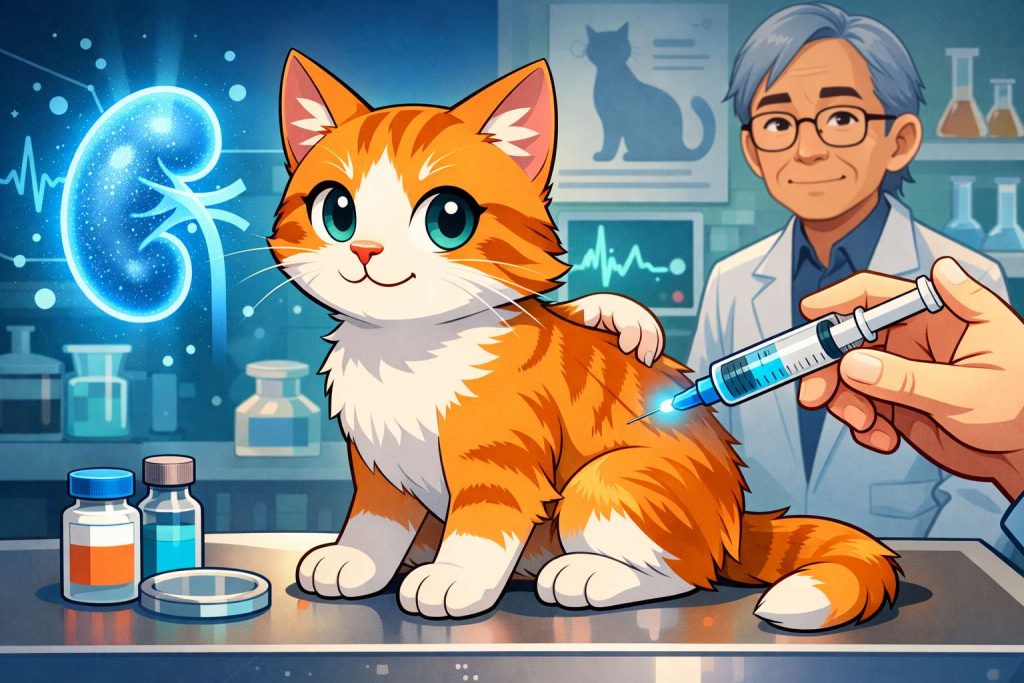
AIM injection for cats is getting real attention, and for good reason. Chronic kidney disease is one of the biggest health threats for older cats. So when a Japan-based team says it is testing an AIM medicine in clinics, owners notice fast.
You have probably seen headlines that say it can “double a cat’s lifespan.” That result is not confirmed. The project is real, and the early science is serious, but the big promise still needs stronger proof.
The key name here is Toru Miyazaki and his group at The Institute for AIM Medicine. In a public update dated June 13, 2025, the institute said its clinical trial for the AIM cat medicine started at 26 veterinary hospitals across Japan.
What AIM is, in plain language
AIM is short for “apoptosis inhibitor of macrophage.” It is a naturally occurring protein found in blood. The research idea is that AIM plays a role in how the body clears certain debris and harmful byproducts. So the hope is simple. Help the kidneys handle stress better, then slow the slide that happens in chronic kidney disease.
The institute’s public explanation focuses on a cat-specific point. Cats appear to have trouble using AIM in the same effective way seen in other species. So the team is testing whether giving recombinant AIM, meaning a lab-made version, can help.
Is this a vaccine, a drug, or “the Miyazaki kidney injection”
A lot of searches call it a “cat kidney vaccine.” That label sticks, but it is not accurate in the usual medical sense.
A vaccine trains the immune system to prevent a disease trigger, often an infection. This AIM product is an injected medicine that aims to change a biological pathway tied to kidney damage. So it fits the “drug” bucket, not the classic “vaccine” bucket.
People search “Miyazaki kidney injection” and “AIM injection cats” for the same reason. They want a single shot that blocks kidney failure. The public information does not support that kind of simple, one-and-done story. The goal is slowing disease progression, not instant reversal.
What the latest clinical paper says
A peer-reviewed paper indexed on PubMed reports an exploratory clinical study on recombinant AIM in cats with advanced chronic kidney disease. The paper describes screening a larger group, enrolling cats in a defined creatinine range, then tracking outcomes over 360 days.
The paper reports better survival in treated cats in that study setting, plus shifts in some kidney-related markers and metabolites. It also calls the work exploratory and non-pivotal. That wording matters. It signals early clinical evidence, not final confirmation for broad everyday use.
So yes, there is published clinical work. But no, it does not prove “double lifespan.” It supports the case for larger trials and tighter answers on dosing, safety, and who benefits most.
Trial status and release date
The clearest official public milestone is the June 2025 statement that the trial began across 26 veterinary hospitals in Japan.
Past that point, public details are limited. The institute’s updates show active R&D and publications, but they do not give a confirmed public release date for routine veterinary use. I cannot confirm an official launch date.
Cat kidney vaccine cost and 2025 price searches
People search “cat kidney vaccine 2025 price” and “Toru Miyazaki cat vaccine cost” every day. Right now, there is no official public pricing on the institute’s English pages. I cannot confirm a cost.
If this medicine reaches approval, pricing will depend on country, clinic, supply, and how dosing works in practice. And costs will sit on top of usual CKD care, which often includes labs, diet changes, and long-term meds.
What prevents kidney failure in cats right now
There is no single step that prevents kidney failure in every cat. Still, owners can lower risk and slow chronic kidney disease with steady basics. These steps matter today, even if AIM becomes available later.
- Routine screening as cats age
Blood tests and urine tests help catch problems earlier. Vets often use the International Renal Interest Society staging system to guide care and monitoring. - Renal diet when your vet advises it
Prescription kidney diets focus on phosphorus control and tailored nutrition. For many cats, that can slow progression. - Hydration support
Wet food, water access, and vet-guided fluid plans can help. Dehydration puts extra strain on kidneys. - Blood pressure checks
High blood pressure can speed kidney damage. Testing is quick, and treatment can help. - Toxin awareness
Some toxins can wreck kidneys fast, lilies are a big one. Act fast if exposure is possible.
If you are sorting out food choices right now, this guide is a good next read: Is dry food bad for cats’ kidneys. the clear answer and easy ways to feed safer.
Why people say cats live longer in Japan
A few practical reasons show up again and again.
Indoor living is common in many households, so cats face fewer cars, fights, and infections. Vet access is strong in many areas, and routine care is common. Pet insurance datasets in Japan also track longevity and disease patterns closely, so trends get spotted faster.
Still, there is no magic national trick that blocks kidney disease. Age remains the biggest risk factor for CKD, and that is true everywhere.
What to watch next
So what should you watch for next.
Look for larger trial results, then look for clear approval statements for veterinary use. Watch for detailed safety reporting, not just survival headlines. And keep an eye on whether the institute publishes dosing guidance that regular clinics can follow.
AIM injection for cats is one of the most watched kidney disease projects in the cat world. The trial start is confirmed, and a clinical paper is on record. The rest, like price and release date, is still not confirmed.