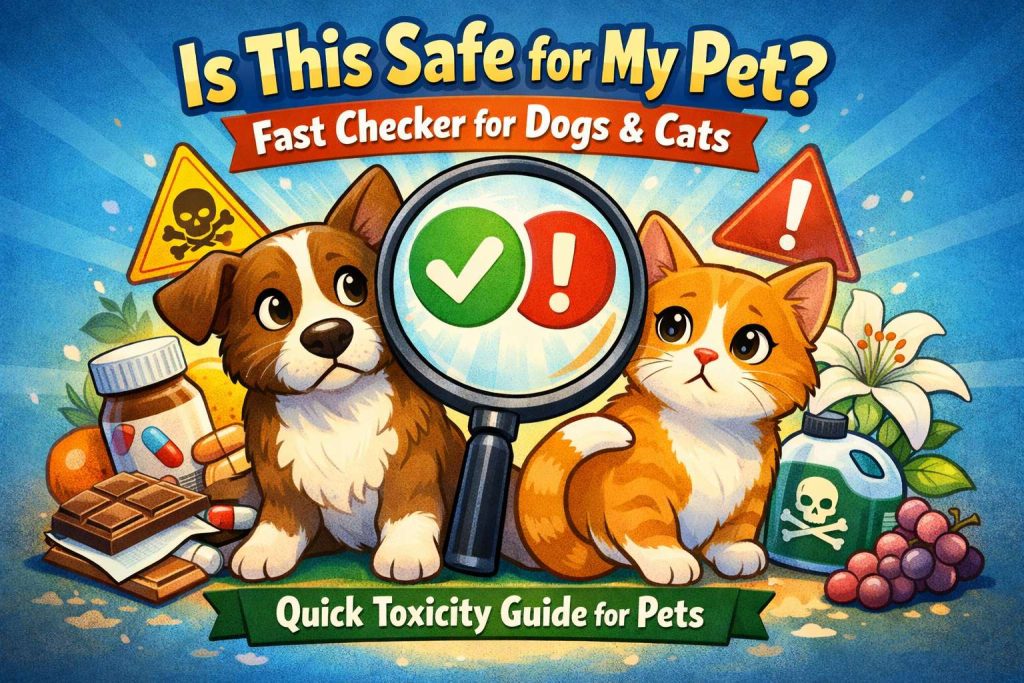
When you find your pet licking something off the floor, chewing a plant, or stealing a snack, you usually have the same question. Is this safe for my pet?
This guide gives you a practical “Is This Safe for My Pet?” checker you can use in under a minute. It also tells you what information a vet or poison service will ask for, what signs matter most, and which items should trigger immediate action.
Is This Safe for My Pet?
Fast checks, simple language, and clear next steps.
The 30-Second “Is This Safe for My Pet?” Checker
Use this as a quick triage tool. It does not replace veterinary advice. If your pet is collapsing, seizing, struggling to breathe, or acting severely unwell, treat it as an emergency and go to an emergency vet now.
Step 1: Identify the exact item
Be specific. “Gum” is not enough. You want brand and ingredients if possible.
- Food. Include flavor and sweeteners.
- Medication. Include strength (mg), form, and how many tablets.
- Plant. Include a photo of leaves and flowers.
- Chemical. Include the product name and concentration.
Step 2: Confirm the pet details
Write these down:
- Species (dog, cat, rabbit, bird, etc.)
- Breed type and age (puppy, kitten, senior)
- Weight (even an estimate helps)
- Current health issues and current meds
Step 3: Estimate exposure
You do not need perfect math. You do need a reasonable estimate:
- How much could they have eaten or licked?
- When did it happen?
- Was it a one-time bite, or repeated access?
Step 4: Check for “red flag” symptoms
These signs often matter in poison calls and vet triage.
- Vomiting or diarrhea (with or without blood)
- Drooling, pawing at the mouth
- Lethargy or sudden weakness
- Tremors, wobbliness, collapse, seizures
- Pale gums, yellow gums or skin
- Trouble breathing
- Bloody stools
Step 5: Sort the situation into one of 3 risk levels
This keeps you from guessing.
Risk Level A: Emergency now
Act immediately if any of these are true:
- Severe symptoms (collapse, seizures, breathing trouble).
- Your cat had any exposure to true lilies (even small exposure can be dangerous).
- Your dog may have eaten xylitol (common in sugar-free gum, candies, some peanut butters, and other products). Signs can start quickly.
- Any exposure to antifreeze containing ethylene glycol. Very small amounts can be lethal.
- Possible ingestion of human pain relievers without veterinary direction (especially acetaminophen in cats).
Risk Level B: Call a vet or pet poison service right now
Act fast, even if symptoms are mild or not present yet:
- Grapes, raisins, currants, sultanas. Toxic dose is unpredictable, and any ingestion should be treated as serious.
- Chocolate, especially dark or baking chocolate.
- Rat or mouse bait, insect bait, pesticides, strong cleaners, or pool chemicals.
- Vape liquids, nicotine products, or certain essential oils (tea tree oil is a known high-risk example for pets, especially cats).
Risk Level C: Monitor, but document and reassess
This is for low-risk items in small amounts when your pet is acting normal. Even then, keep notes and watch closely for 24 hours. If you see symptoms, upgrade to Level B.
If you are unsure, treat “unknown” as higher risk. That is safer.
What to Do Next. The exact call script
When you call a vet, emergency clinic, or animal poison service, use this script. It speeds up help and reduces mistakes.
- “My pet is a [species], [weight], [age].”
- “They got into [exact product name].”
- “It happened about [time] ago.”
- “The maximum amount could be [estimate].”
- “Current symptoms are [list].”
- “Here is the ingredient list and strength if it is medication.”
Poison hotlines to keep saved
- ASPCA Animal Poison Control Center: 888-426-4435 (consultation fee may apply).
- Pet Poison Helpline: 855-764-7661 (fees apply).
If you call, stay calm and stay on the line. Also keep the product packaging nearby.
Do not do these common “home fixes”
These are popular online, but they can worsen outcomes.
- Do not induce vomiting unless a veterinary professional tells you to. Vomiting is sometimes unsafe, depending on the toxin.
- Do not give food, milk, or “antidotes” unless instructed.
- Do not wait for symptoms if the item is known high risk. Several toxins cause severe injury before obvious signs show.
High-risk items people search for most
These are common searches like “can dogs eat,” “is it toxic to cats,” and “pet poison checker.” Use this list as a fast shortcut, then still run the checker above.
Xylitol (dogs)
Xylitol can cause a rapid drop in blood sugar, and it can also be linked to severe outcomes. Early signs can include vomiting followed by weakness, staggering, collapse, and seizures.
If xylitol is possible, treat it as Level A.
Lilies (cats)
True lilies, including many common bouquet lilies, can cause acute kidney injury in cats. Signs can start within hours, and kidney failure can occur within days if untreated.
If you have cats, the safest rule is “no lilies in the home.”
Grapes and raisins (dogs)
Dogs can develop acute kidney injury after eating grapes or raisins. The toxic amount is unknown, and sensitivity varies, so any ingestion is serious.
Chocolate (mostly dogs, can affect cats too)
Chocolate contains theobromine, and darker chocolate tends to contain more. Signs can include agitation, increased heart rate, tremors, and seizures in severe cases.
Human pain relievers
Many human pain medicines are dangerous for pets without veterinary direction. Acetaminophen is especially dangerous for cats.
If a pet swallowed any of these, call right away and bring the bottle.
Antifreeze (ethylene glycol)
Ethylene glycol antifreeze has a small lethal dose, and it is often described as sweet tasting. A few teaspoons can be enough to kill.
If exposure is possible, do not wait.
Household chemicals and pest products
Cleaners, bleach, toilet bowl cleaners, rat poison, weed killers, pool chemicals, and ice melt products can be dangerous. Some flea and tick products for dogs can be life-threatening if used on cats.
How reliable is this checker?
This checker is strongest when the item is well-known and well-documented (for example xylitol, lilies, antifreeze, acetaminophen, grapes, and chocolate).
It is less reliable when:
- The product is a mixture with unclear ingredients.
- The pet’s exposure amount is unknown.
- The pet has underlying disease or is very small, very young, or very old.
In those “uncertain” cases, I cannot confirm safety from a checklist alone. Treat uncertainty as higher risk and call.
Prevention tips that actually reduce emergencies
These steps prevent the majority of household poison incidents:
- Store meds and supplements in closed cabinets, not purses or nightstands.
- Keep sugar-free products and gum out of reach.
- Avoid lilies if you have cats.
- Keep grapes, raisins, chocolate, and baked goods secured.
- Use pet-specific parasite products, and never apply dog products to cats.
- Clean spills immediately. This matters for antifreeze and cleaners.
- Save poison numbers in your phone now, not during the crisis.
Quick summary you can screenshot
If you remember only this:
- Identify the item and ingredients.
- Note pet weight and time since exposure.
- Check symptoms.
- If it is a known high-risk item or symptoms are severe, go now.
- Otherwise call a vet or pet poison service with your notes.
- Do not induce vomiting unless told to.