New Delhi. January 28, 2026.
India’s street dog debate feels louder than ever, and that is not only about barking. People want safe streets, and people still want humane treatment for animals. So the legal framework now pushes cities toward a clear routine: sterilise, vaccinate, manage feeding, and control garbage. Then the Supreme Court has added extra guardrails for places where risk stays high.
What the “new law” says about stray dogs in India
The central government notified the Animal Birth Control (ABC) Rules, 2023 under the Prevention of Cruelty to Animals Act, 1960. These rules replaced the older 2001 dog rules, and they put the day to day responsibility on local bodies. That means municipal corporations, municipalities, and panchayats have to run sterilisation and anti rabies vaccination programs for street dogs.
The core method is straightforward. Catch the dog, sterilise it, vaccinate it, and then release it back to the same area. This “return to the same place” approach stays the baseline, and it exists for a reason. It keeps dogs from being dumped into new territories, and it reduces pack fights that often follow relocation.
At the same time, the rules and court directions accept that some dogs do not fit the routine. So the framework includes defined exceptions for higher risk cases.
What the Supreme Court decided on stray dogs in India
Two recent Supreme Court directions shape how cities act right now, and they matter for residents who feel stuck between safety and compassion.
August 22, 2025. Return to the same area stays the default.
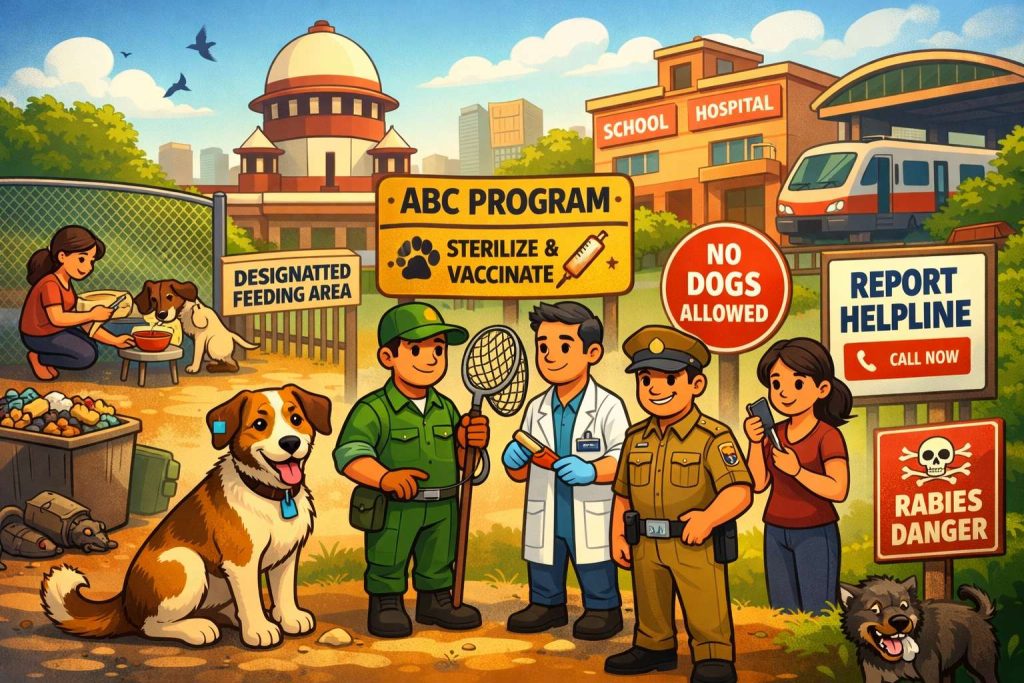
In a judgment dated August 22, 2025, the Court stated that picked up dogs should be sterilised, dewormed, vaccinated, and then released back to the same area they came from. But the Court also marked clear exceptions. Dogs infected with rabies, dogs suspected of rabies, and dogs showing aggressive behaviour should not go back to the streets after the required handling steps. Then authorities should keep them in separate shelters when possible.
That same judgment added a practical rule about feeding. It directed municipal authorities to create dedicated feeding spaces in each ward, put up signage, and stop feeding on streets. It also directed a helpline number so people can report violations.
November 7, 2025. Institutional areas get a stricter rule.
In an order dated November 7, 2025, the Court focused on “institutional” settings such as schools, hospitals, sports complexes, bus stands, and railway stations. It directed that stray dogs found inside these premises must be removed and shifted to a designated shelter after sterilisation and vaccination, and not released back to the same location. That is a big line in the sand, and it is meant to reduce risk in high footfall zones.
The order also tied public health readiness to the dog issue. It called for hospitals to keep anti rabies vaccine and immunoglobulin stock, and it asked for awareness sessions in schools on bite prevention and reporting.
Is dog barking illegal in India
There is no single national “dog barking law” that makes barking, by itself, a crime. Still, the legal system does not ignore noise or disturbance. So the risk starts when barking turns into a public nuisance, or when it keeps going after authorities step in.
India’s Bharatiya Nyaya Sanhita, 2023 includes the concept of public nuisance, framed around acts or illegal omissions that cause common injury, danger, or annoyance to the public. Then the law provides a punishment section for public nuisance cases not covered elsewhere, with a fine that can extend to one thousand rupees. Next, procedure rules in the Bharatiya Nagarik Suraksha Sanhita, 2023 give a Magistrate power to stop repetition or continuance of a public nuisance.
So barking is not “illegal” on its own. Yet persistent disturbance, backed by facts, can trigger nuisance action.
Why street dog policy often fails in real life
Sterilisation and vaccination work best when a city runs them at scale, and when basic sanitation does its job. But many places struggle with both.
Open garbage feeds dogs, and it keeps packs rooted around food points. Then the number of dogs rises, and conflicts rise with it. Street feeding in random corners adds another pressure point, and it sparks resident versus resident fights. In fact, many local disputes start with food bowls near entrances, staircases, playgrounds, or parked cars.
So the policy problem is not only “dogs.” It is street level management, day after day, even when people are tired of talking about it.
If you want a lighter read after all this policy, here is a fun political pet story: Larry the Cat at 19, still acting like Downing Street is his house.
How to control street dogs in India without breaking the law
Residents often ask for one quick fix, but the legal model points to a sequence. So here is a practical plan that matches the ABC Rules 2023 and the recent Supreme Court directions.
Run ABC and anti rabies vaccination as one tracked program.
Ask your local body for ward wise pickup plans, sterilisation counts, vaccination counts, and timelines. Then ask for public reporting, even a basic monthly update. Transparent numbers cut rumours, and they push action.
Use ward feeding spaces, not street corners.
Support designated feeding spaces with signage and clear boundaries. Then discourage feeding on roads and near entrances. This reduces conflicts, and it keeps food away from traffic and school routes.
Treat schools, hospitals, stations as strict zones.
Report dog presence inside these premises through official channels. Then request removal and shifting to shelters after the required procedures, with non return to that same site. This aligns with the Court’s direction for institutional areas.
Flag aggressive or suspected rabies cases fast.
Report bite incidents and high aggression quickly, and insist on proper handling. The Court’s exception for suspected rabies and aggressive dogs exists for public safety, so it needs quick reporting to work.
Cut food sources by tightening waste control.
Secure bins, cover community containers, and stop open dumping. Then focus on markets, roadside eateries, meat and fish areas, and garbage points. These spots drive pack density, so they are the first targets.
Push adoption and responsible care.
Support adoption through legal channels, and promote vaccination records and tagging. Adoption reduces street pressure, and it turns a conflict into a practical outcome. It is not magic, but it helps.
Dog bites: what to do right away
When a bite happens, the first minutes matter. Wash the wound with soap and running water as soon as possible, and keep washing for a long stretch, up to 15 minutes, when available. Then seek medical care quickly for rabies risk assessment and post exposure vaccination guidance.
Rabies is preventable with proper post exposure care, and it is deadly once symptoms start. So treat bites and scratches as urgent, even when the wound looks small.
What this looks like in 2026
The direction is clear. Local bodies run sterilisation and vaccination at scale, and feeding moves off streets into mapped ward spaces. Then sensitive public premises get stricter removal rules, and high risk dogs fall into exceptions that block release back to the same area.
This model will feel strict in some places, and it will feel overdue in others. Still, it aims at one steady outcome: fewer packs, fewer bite incidents, and fewer neighbour fights.